9th CLASS PHYSICS CHAPTER 3 NUMERICAL
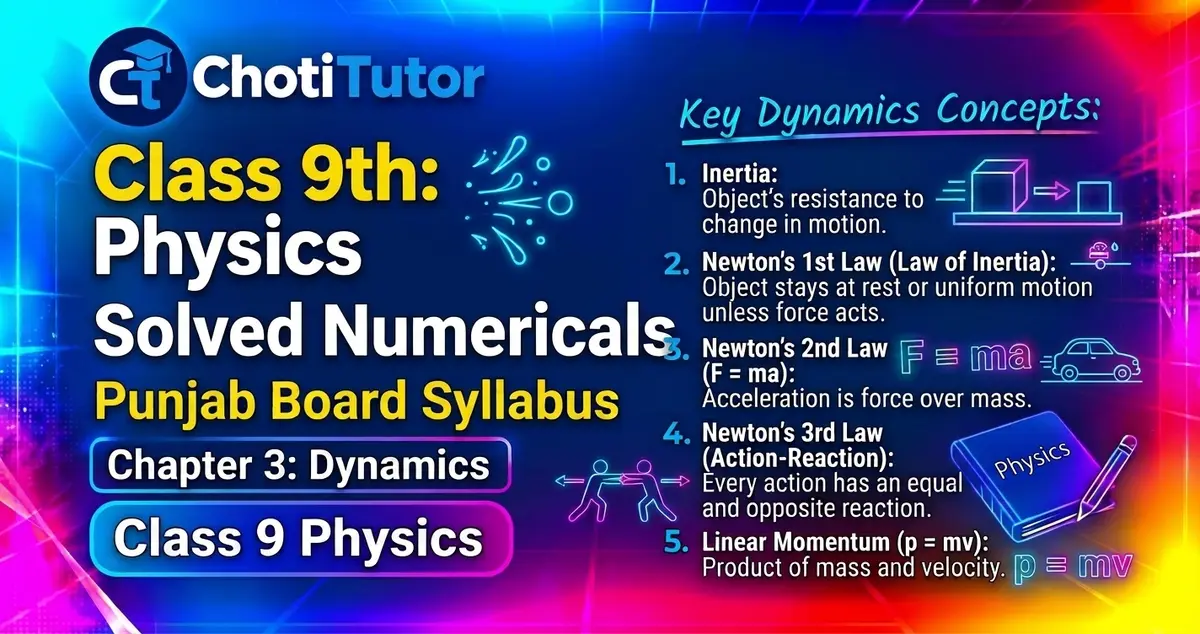
Welcome to ChotiTutor, here you will get 9th class physics chapter 3 numericals. This chapter is the most important in the 9th grade physics curriculum. These solutions are fully updated according to the latest syllabus issued by the Punjab Curriculum and Textbook Board.
3.1. A 10 KG block is placed on a smooth horizontal surface. A horizontal force of 5 N is applied to block. Find:
(a) The acceleration produced in the block.
(b) The velocity of block after 5 seconds
Solution:
Given data:
a) Mass: m = 10 kg
Force: F = 5 N , Acceleration: a =?
As we know
(b) t = 5 s, v = ?
Result: The acceleration produced in the block is and the velocity of block after 5 seconds is .
3.2. The mass of a person is 80 kg.What will be his weight on the earth? What will be his weight on the moon? The value of acceleration due to the gravity of the moon is .
Solution:
Given Data:
ge =
we = ?
Now weight on moon:
Result: The weight of the person on the earth is 800 N and the weight on moon is 128N.
3.3. What force is required to increase the velocity of 800kg car from to in 10 seconds?
Given data:
Mass: m = 800 kg
initial velocity:
final velocity:
time:
force:
As we know
Result: The force required to increase the velocity from to is 1600 N.
3.4 A 5 g bullet is fired by a gun. the bullet moves with a velocity of . If mass of gun is 10 kg, find the recoil speed of the gun.
Given Data:
mass of bullet:
speed of bullet:
mass of gun:
Recoil speed of gun;
solution:
3.5 An astronaut weighs 70 kg. He throws a wrench of mass 300 g at a speed of . Determine:
a) The speed of astronaut as he recoils away from the wrench.
b) The distance covered by the astronaut in 30 minutes.
Given Data:
Mass of astronaut:
Mass of wrench:
Throwing Speed:
Recoiling Speed:
Solution:
a)
b)
3.6 A bogie of a goods train is moving with a velocity of . Another bogie of mass coming from behind with a velocity of collides with the first one and couples to it. Find the common velocity of the two bogies after they become coupled.
Given Data:
Mass of bogie:
Velocity:
Mass of 2nd bogie:
Velocity:
common velocity:
Solution:
3.7 A cyclist weighing rides a bicycle of mass . He starts from rest and applies a force of 90 N for 8 seconds. Then he continues at a constant speed for another 8 seconds. Calculate the total distance travelled by the cycle.
Given Data:
Mass of cyclist:
Mass of cycle:
Initial velocity:
Applied force:
time:
Distance covered:
Solution:
Distance covered for first time
Distance covered in constant speed
Total distance =
Result: Total distance travelled by the cyclist is 144 m.
3.8 A ball of mass 0.4 kg is dropped on the floor from a height of 1.8 m. The ball rebounds straight upward to a height of 0.8 m. what is the magnitude and direction of the impulse applied to the ball by the floor?
Given Data:
mass:
Magnitude of impulse = ?
Direction of impulse = ?
Solution:
We take initial velocity as negative because the ball moves downward, so .
⇒
The final velocity is positive because the ball rebounds upward.
Now impulse
)
Result: The magnitude of the impulse is 4 Ns and direction is vertically upward.
3.9 Two balls of masses 0.2 kg and 0.4 kg are moving towards each other with velocities and respectively. After collision, the velocity of 0.2 kg ball becomes . What will be velocity of 0.4 kg ball?
Given Data:
mass of 1st ball:
mass of 2nd ball:
initial velocity of 1st ball:
initial velocity of 2nd ball:
final velocity of 1st ball:
final velocity of 2nd ball:
Solution:
Result: The velocity of 0.4 kg ball will be
Next Step: Once you have mastered these basics, move on to the next section by checking out our Class 9 physics Solved Numericals Chapter Index for a full overview of the syllabus.